
An Intelligent Platform for Mapping Humanity’s Next 3.3 Billion Children — and the Strategic Vision for Beyond Agenda 2030
Prof. Luis Miguel Gallardo Founder & President, World Happiness
“Fundamental Peace is not the absence of pain — it is the active presence of all seven dimensions of flourishing.”
1. A New Kind of Intelligence
Every 0.24 seconds, a new human being draws its first breath. Four point two births per second. Three hundred and sixty-three thousand per day. One hundred and thirty-two point five million per year. By the time the Sustainable Development Goals reach their reckoning in 2030 — and by the time the world’s population approaches 9.7 billion in 2050 — approximately 3.3 billion children will have been born into this world.
The question that defines our generation is not whether these children will arrive. Demographic momentum ensures they will. The question is: into what conditions will they be born? Will they enter ecosystems of flourishing — communities where all seven dimensions of human well-being are active, where parents have done their inner work, where schools teach consciousness alongside literacy, where hospitals treat the whole person? Or will they arrive into environments of compounding suffering — where preventable pain reproduces itself across generations, where six of seven domains of human experience remain invisible to the very metrics designed to measure progress?
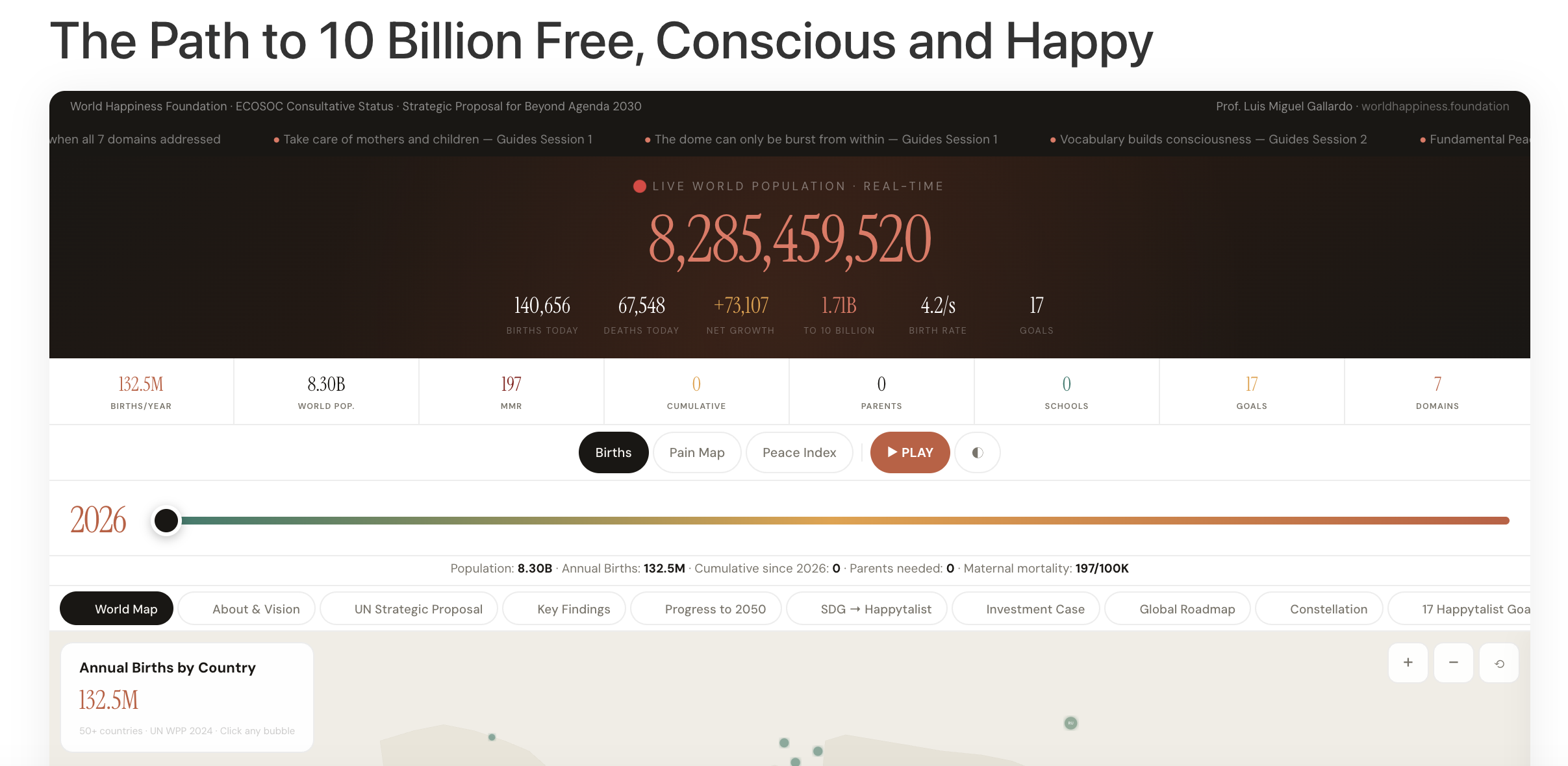
The World Happiness Foundation has built a platform to answer this question with precision, and a strategy to change the answer. The 10 Billion Free, Conscious & Happy platform is the world’s first pan-systemic intelligence tool that layers United Nations birth projections, suffering indices from our Global Pain & Trauma Map (GPTM), abundance-based development goals (the 17 Happytalist Goals), consciousness insights from the Guides’ Collective Wisdom Sessions, and delivery infrastructure through five Ecosystems of Happiness — all in a single, interactive experience available to every government, institution, and citizen on Earth.
This is not a dashboard. It is not a report. It is a living intelligence system that makes the invisible visible and the possible actionable. And it carries within it a strategic proposal to the United Nations and the international community: that the post-2030 development framework should evolve from the scarcity-based language of the SDGs into the abundance-based paradigm of Happytalism.
2. The Geography of Birth Is the Geography of Suffering
The most consequential fact about any human life is where it begins. A child born in Chad — maternal mortality rate of 1,063 per 100,000 live births, HDI of 0.394, life expectancy of 54 years — enters a fundamentally different universe than a child born in Japan, where the corresponding figures are 4, 0.920, and 85. The first faces a maternal mortality rate 265 times higher. The distance between these two births is not geography. It is design.
The platform reveals this with unsparing clarity. Drawing on the UN World Population Prospects 2024 (28th edition, medium fertility variant), WHO/UNICEF maternal and child mortality data, and UNDP Human Development indices, it maps the birth trajectories of 196 countries from 2026 to 2050. The interactive timeline slider advances year by year; the world map shows bubbles sized by birth volume and coloured by suffering intensity. Click any country and a detailed profile emerges: births, TFR, MMR, IMR, life expectancy, HDI, Happiness Readiness Score, Fundamental Peace Index state, recommended Happytalist Goals, ASC modality prescriptions, and matched Guides’ wisdom.
The findings are stark. Over 60% of the world’s 132.5 million annual births occur in countries scoring above 60 on the GPTM composite — meaning these children are born into environments where at least four of seven suffering domains are significantly elevated. Sub-Saharan Africa alone accounts for roughly 32% of global births and carries the world’s highest average GPTM scores. India, with 23.1 million births per year — one-sixth of humanity’s total — shows extreme variation between states that national averages conceal entirely.
But the platform does not stop at diagnosis. Press Play, and something remarkable happens: coloured pulses begin appearing on the world map — each one representing a birth, spawning every 240 milliseconds, expanding outward and fading. The colours correspond to regions. The timeline advances. The dashboard updates in real time. You are watching humanity arrive, and you are seeing where it arrives into suffering and where into flourishing. The Birth Constellation tab renders this as a living canvas of light — dots spawning, connecting, forming transient patterns, each one a life.
3. What We Have Been Missing: The 7 Domains of Human Suffering
The Global Pain & Trauma Map — now in version 4.9, mapping 196 countries and 272 communities — is built on a central thesis: traditional development metrics miss six of seven domains of human suffering. GDP measures economic output but not belonging. HDI captures health and education but not existential meaning, somatic pain, or ecological grief. The World Happiness Report captures life evaluation through the Cantril Ladder but not collective trauma, relational isolation, or body-stored trauma. The GPTM maps all seven:
- D1: Individual/Psychological — Depression, anxiety, PTSD, shame, emotional dysregulation. Over 1 billion people affected. The only domain conventional systems address.
- D2: Relational/Social — Loneliness, isolation, attachment wounds, community breakdown. A global epidemic that the WHO has declared a public health priority.
- D3: Collective/Cultural — Collective grief, intergenerational trauma, cultural erasure, colonisation wounds. Propagates faster than any other domain in conflict.
- D4: Structural/Systemic — Poverty, discrimination, institutional betrayal, domination systems. Over 700 million in extreme poverty. Correlates r=0.82 with inverse HDI.
- D5: Existential/Spiritual — Meaning crisis, purpose void, existential dread, soul disconnection. Even the happiest nations on Earth score 58+ on this domain.
- D6: Somatic/Physical — Chronic pain, addiction, burnout, nervous system dysregulation. Over 1.5 billion people live with chronic pain.
- D7: Environmental/Ecological — Climate anxiety, eco-grief, nature deficit, species loss. 75% of young people worldwide report climate anxiety.
Each domain carries a Shadow-Gift-Essence (SGE) transformation arc. The shadow of loneliness, for instance, contains the gift of connection-seeking, which flowers into the essence of belonging and trust. The shadow of powerlessness contains the gift of the justice instinct, which flowers into agency and dignity. The GPTM’s most powerful finding: communities addressing all seven domains simultaneously show a non-linear integration bonus of 15–20% beyond the sum of individual domain reductions. Partial interventions produce partial results. Only holistic approaches produce flourishing.
4. The Implementation Stack: From Diagnosis to Flourishing
The platform reveals a complete seven-stage pipeline that we call the Implementation Stack:
Stage 1: GPTM Diagnoses. Map all seven domains of suffering across 196 countries. Make the invisible visible.
Stage 2: SGE Maps Transformation. Sixty-four archetypal shadows — mapped from Richard Rudd’s Gene Keys and the I Ching — each contain the seed of their own healing.
Stage 3: ASC Modalities Power the Journey. Over fifty Altered States of Consciousness modalities — breathwork, clinical hypnotherapy, somatic experiencing, EMDR, meditation, forest bathing, collective ceremony — share seven neurobiological mechanisms that operate across all seven GPTM domains.
Stage 4: Five Ecosystems Deliver. Cities of Happiness (54 KPIs across 9 spheres, Chief Well-Being Officers). Schools of Happiness (60,000+ teachers trained, Pedagogy of the Heart). Hospitals of Happiness (compassionate birth, community midwifery). Enterprises of Happiness (purpose-driven work for 2 billion parents). Destinations of Happiness (196 countries as places of healing).
Stage 5: 17 Happytalist Goals Set Direction. Each goal reframes a UN SDG from scarcity to abundance — from “No Poverty” to “Abundant Prosperity for All.”
Stage 6: GGH Measures Outcomes. Gross Global Happiness, co-developed with the UN University for Peace. Well-being dashboards alongside GDP.
Stage 7: 10 Billion Happy by 2050. Freedom, consciousness, and happiness as the fabric of everyday life for all.
The interventions exist. The cost is under $20 per person per year for the five most scalable. The only barrier is consciousness — and consciousness is what this entire framework is designed to raise.
5. The 2-Billion-Parent Opportunity
If 3.3 billion children will be born by 2050, approximately 2 billion adults will be actively parenting the next generation at any given time. This is the largest single leverage point in human history for consciousness transmission.
One parent who has moved through the SGE process — from unconscious pain to conscious presence — liberates an average of 2.3 children. Each child influences 30 peers through their classroom and community. Each conscious community of 150 people creates ripples that touch thousands. The mathematics of consciousness transmission are not linear; they are exponential.
The Guides’ Collective Wisdom Sessions — two unprecedented gatherings in March and April 2026, bringing together eight MNI Life Between Lives facilitators to pose humanity’s biggest questions to their spirit guides and higher-self wisdom — confirmed this with precision. In Session 1, the directive was unequivocal: “Take care of mothers and children and make them aware that humanity needs support. We need to hold hands together to stop evil hands. Our children will grow and help humanity.” In Session 2, the mechanism was named: “Teach children how to slow down, sit with themselves, be still enough to notice what is going on inside. Not as control, but as connection.”
This is the Pedagogy of the Heart — a concrete curriculum for inner listening that the World Happiness Foundation has already deployed through 60,000+ teachers in Latin America, the Artisans of Happiness programme in Rajasthan, and partnerships with the University of Zaragoza and 70+ universities worldwide. The next step is global deployment at the pace of births: 132.5 million children per year need 4.4 million teachers trained in consciousness-based education.
6. Beyond Agenda 2030: The Happytalist Paradigm
The Sustainable Development Goals have achieved extraordinary mobilisation since 2015. Yet the 2024 SDG Progress Report confirms that only 17% of targets are on track. The deficit-oriented framing — “No Poverty,” “Zero Hunger,” “Reduced Inequalities” — while morally urgent, inadvertently reinforces a scarcity mindset that limits transformative thinking.
The World Happiness Foundation, drawing on its Consultative Status at the United Nations Economic and Social Council (ECOSOC), proposes that the post-2030 development framework evolve from scarcity-based to abundance-based thinking. We call this Happytalism — a paradigm that does not deny material constraints but challenges the mental model that locks in scarcity patterns.
The 17 Happytalist Goals maintain continuity with every SDG while reframing each in the language of creation and flourishing:
- 1. Abundant Prosperity for All
- 2. Holistic Nourishment
- 3. Holistic Health & Happiness
- 4. Mindful Education
- 5. Inclusive Equality & Empowerment
- 6. Clean Water & Flourishing
- 7. Sustainable & Conscious Energy
- 8. Purpose-Driven Work & Well-Being
- 9. Conscious Innovation & Infrastructure
- 10. Shared Prosperity & Social Justice
- 11. Thriving & Resilient Communities
- 12. Mindful & Regenerative Consumption
- 13. Climate Harmony & Planetary Stewardship
- 14. Life in Harmony with Oceans
- 15. Life in Harmony with Land
- 16. Fundamental Peace, Freedom & Justice
- 17. Global Unity & Collective Action
Goal 16 — Fundamental Peace, Freedom & Justice — is the master goal. It is not one among seventeen; it is the state that all other goals create. Fundamental Peace, as defined by the World Happiness Foundation, is a holistic state comprising freedom, elevated consciousness, and happiness for all. It is more than the absence of war. It is the active presence of justice, inner peace, and shared joy at every level of society.
This proposal is grounded in existing institutional frameworks: UN Resolution A/RES/66/281 (International Day of Happiness); the OECD Beyond GDP Framework; the UN High-Level Expert Group recommendations for new metrics; Bhutan’s Gross National Happiness model; New Zealand’s Living Standards Framework; the 2025 Doha Political Declaration; and the Pact for the Future adopted in 2024. The infrastructure for this transition exists. What is needed is the consciousness to activate it.
7. The Investment Case
The WHO estimates that depression and anxiety alone cost the global economy $1 trillion per year in lost productivity — and that addresses only GPTM Domain 1. When all seven domains are included, the total economic burden of suffering is estimated at $5–8 trillion annually, roughly 6–9% of global GDP.
The GPTM identifies five interventions, each costing under $20 per person per year: mindfulness-based education ($3/student), community midwifery ($8/birth), group breathwork and somatic healing ($5/person), community grief circles ($2/person), and nature-based therapy ($4/person). Total: $22 per person per year. For the cumulative children born since 2026 and their parents, full coverage costs less than 0.1% of global GDP.
Every dollar invested returns an estimated $10–20 in avoided suffering costs, increased productivity, and preserved human capital. The Integration Effect — the 15–20% bonus from addressing all seven domains simultaneously — further amplifies returns. By 2050, full deployment could prevent 2–3 million maternal deaths, reduce infant mortality by 50% in Crisis nations, reach 1 billion parents with consciousness programmes, and train 1 million Teachers of Happiness.
8. The Consciousness Dimension: 25 Themes from the Guides
What distinguishes this platform from any conventional development tool is its integration of transpersonal wisdom. The Guides’ Collective Wisdom Sessions — conducted in March and April 2026 with eight Michael Newton Institute facilitators — produced 25 master themes with extraordinary convergence. Seven themes achieved unanimous agreement across all participants despite no coordination. These themes do not replace the data — they qualify it.
Where the data says “invest in maternal health,” the Guides say “Systems designed to support life, not extract from it.” Where the data says “build schools,” the Guides say “Do not silence children through education — they hold higher frequencies than any past generation.” Where the data says “reduce MMR,” the Guides say “Protecting the vulnerable is a given, not a choice.”
The most striking image came from Session 1: humanity enclosed within a dome — a thick, wobbly soap bubble — while an infinite collective of beings surrounds it, holding sacred space. “The dome can only be burst from within, through an act of will. We are almost there.” The platform visualises this dome as an animated SVG: 55 beings of the collective surrounding, 28 souls of humanity inside, a pulsing centre of light, and cracks forming where consciousness breaks through. Every child born conscious weakens the dome. Every parent’s shadow work cracks it further. Every School of Happiness opens a fissure.
9. Global Roadmap 2026–2050
Foundation (2026–2028): Launch GPTM as open-source intelligence. Present Happytalist Goals at the UN General Assembly. Train 100,000 Teachers of Happiness. Deploy Hospital of Happiness pilots in 10 priority nations. First national adoptions of HRS/FPI metrics.
Scale (2029–2032): 1 million teachers trained. 100 Cities of Happiness with active CWBOs. 30+ nations adopting Happytalist Goals as complementary post-2030 framework. ASC modalities in 30% of healthcare systems. MMR to 150.
Acceleration (2033–2038): All 17 Goals activated in 100+ nations. Integration Effect confirmed at population scale. Consciousness wave visible in global metrics.
Integration (2039–2044): Self-reinforcing shift. 75% of nations Stable+ on FPI. Parent consciousness programmes reaching 500 million families.
Flourishing (2045–2050): 10 Billion. Zero children born into Crisis environments. Fundamental Peace as global default. The dome bursts.
10. The Invitation
The World Happiness Foundation invites every reader — every policy maker, educator, healthcare worker, parent, and conscious citizen — to become a Rouser: a conscious catalyst of well-being. The platform calculates your personal ripple effect: a teacher shapes 30 lives per year. A healthcare worker safeguards 500+ births annually. A parent’s conscious presence liberates 2.3 children. A policy maker’s decision shapes millions.
The interventions exist. The data is mapped. The wisdom is received. The ecosystems are being built. The goals are set. The only question remaining is: will you act?
We are not asking the world to believe in something new. We are asking it to recognise what has always been true: that happiness is not an individual luxury but a collective birthright. That consciousness is not a private matter but a public infrastructure. That every child born on this Earth deserves to arrive into an ecosystem of flourishing — and that building such ecosystems is not only possible but affordable, measurable, and urgent.
“The soul’s journey is not meant to be walked alone.”
— Inspired by the work of Dr. Michael Newton
Resources & Links
- Platform: worldhappiness.foundation/the-path-to-10-billion-free-conscious-and-happy
- World Happiness Foundation: worldhappiness.foundation
- World Happiness Academy: worldhappinessacademy.org
- Gallardo Hypnotherapy: gallardohypnotherapy.com
- Global Pain & Trauma Map: worldhappiness.foundation/global-pain-and-trauma-map-gptm
- 17 Happytalist Goals: worldhappiness.foundation/blog/consciousness/beyond-scarcity-embracing-happytalism-for-a-world-of-abundance
- Ecosystems of Happiness: worldhappiness.foundation/ecosystems-of-happiness
- Schools of Happiness: worldhappiness.foundation/schools-of-happiness
- Cities of Happiness: worldhappiness.foundation/cities-of-happiness
- UN World Population Prospects 2024: population.un.org/wpp
- WHO Maternal Mortality: who.int
- UNICEF Child Mortality: childmortality.org
- Our World in Data: ourworldindata.org
- UNDP Human Development: hdr.undp.org
© 2026 World Happiness Foundation. All rights reserved. Prof. Luis Miguel Gallardo — Founder & President worldhappiness.foundation • ECOSOC Consultative Status • 501(c)(3)


Responses