
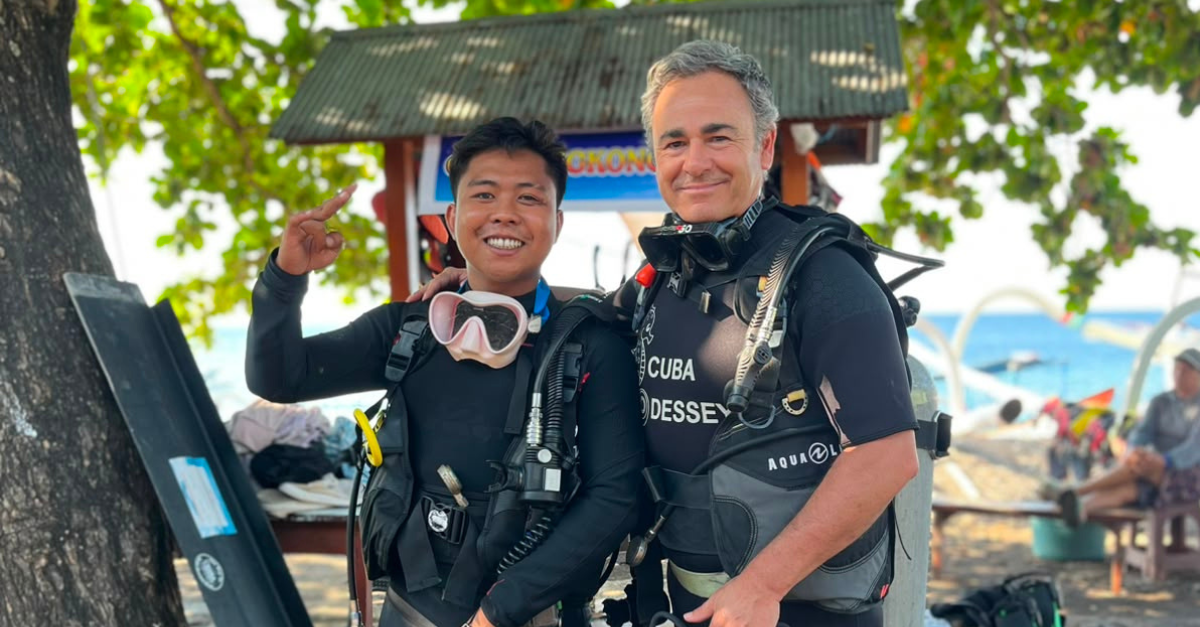
BALI · PURNAMA · JULY 2026
A first-person essay from Bali by Luis Miguel Gallardo — a full-moon night dive, rescue training, and the seven practices the ocean teaches about calm, care and transpersonal leadership.
Descent
On the night of Purnama — the full moon that Bali honours with water, incense and flowers — we stepped off the edge of the boat into black water. A giant stride, one hand holding mask and regulator, a torch in the other, and the sea received us the way the sea receives everything: without ceremony, and completely.
The first thing that changes at night is sound. The ocean becomes a listening room. You hear your own breath — the long draw of air, the silver rush of bubbles — and you remember the first rule every diver ever learns: never hold your breath. Keep breathing, always. Underwater this is not a wellness slogan; it is physiology, it is law, it is life. The lungs must remain open to the exchange. So must we.
Our torch beams crossed in the dark like slow lighthouses. Above us the surface rocked with a light chop, and the moon broke and reassembled itself on the ceiling of the sea — a trembling silver coin. At one point we covered our lights, waved a hand through the black, and the water answered with sparks: plankton igniting like a private sky. Stars above the surface, stars below it. As above, so below.
The calm beneath
Then we descended past ten metres, and everything went quiet.
This is the ocean's first teaching, and in years of diving it has never stopped being true: the turbulence lives at the surface. Wind, chop, spray, noise — all of it belongs to the thin border between worlds. Drop a few metres and you enter a vast, patient calm. The storm is real, but it is not the whole story. It is not even most of the story.
Consciousness is built the same way. Our agitation is superficial in the precise sense of the word: it belongs to the surface. Beneath the mind's weather there is a depth that has never once been disturbed, and the practice — in meditation as in diving — is simply learning to descend to it on purpose.
And yet the depth is not motionless. There are currents down there: broad, silent forces that never announce themselves. In Bali they can take you mid-breath, like a decision made on your behalf. Here the ocean gives its second teaching: you do not fight a current. Fighting it burns your air, your muscles and your judgement. Instead you read it. You align your body, refine your profile, stay beside your buddy — and you let it carry you. What could have been a struggle becomes flight. Divers call it drift diving. I have come to call it the physics of surrender with awareness: not passivity, not control, but a third thing that only exists in relationship with the force itself.
I have written elsewhere that "Fundamental Peace is not the absence of pain; it is the transmutation of its energy into love and compassion." Under the surface I would say it like this: peace is not still water. Peace is right relationship with the current.
An ancient teacher
She rose from behind a coral formation with no more urgency than the moon crossing the sky: a sea turtle, old enough to be unimpressed by us. We hung in the water beside her, torches dimmed out of respect, and for a few minutes she taught the masterclass no certification can give: perfect buoyancy without visible effort, no hurry, no argument with the water. She was not managing the ocean. She was of it.
The Balinese say the world rests on Bedawang Nala, the cosmic turtle, the great serpents coiled around him holding everything steady. I understand that image better underwater than I ever did on land. Some beings carry the world by doing nothing more than being — fully, calmly — what they are. In my work I call that stage essence embodiment: the point where transformation stops being effortful and starts looking like grace. The turtle has no name for it. She simply swims that way.
Stop. Breathe. Think. Act.
These weeks in Bali I have been deepening into rescue training, and rescue begins with an uncomfortable truth: underwater, the equipment rarely fails first. The mind does. Panic is the only real emergency; everything else is a task.
That is why every diver on Earth is taught the same four words for the moment something goes wrong: Stop. Breathe. Think. Act. Read them slowly and you will recognise them, because they are the smallest complete unit of emotional alchemy I know.
Stop is the interruption of unconscious reactivity — the split second in which you refuse to let fear pilot the body. In shadow work we call this naming the shadow: I see you, panic. The controls are not yours.
Breathe is the somatic anchor. One slow exhalation tells the nervous system the ancient news it is waiting for: we are alive, we have air, there is time. The breath is the one instrument that plays the body and the mind at once.
Think is the discovery that the gift was already there. Your training holds the response; fear was simply standing in front of it. Anxiety, crossed with awareness, becomes what it always wanted to become — attention first, then courage.
Act is the micro-action: one clear thing, done calmly, and then the next. Not the whole rescue at once. One thing.
Shadow, anchor, gift, action. Fear transmuted into presence. The whole protocol fits on a dive slate, and it is the same protocol I teach leaders on land — because a boardroom in crisis and a flooded mask at eighteen metres are, to the nervous system, close cousins.
Never dive alone
Diving has one social law above all others: you do not dive alone. Before every descent, buddies check each other piece by piece — air open, releases located, regulators breathing, weights secure. It looks like procedure. It is actually a liturgy: trust, built by hand, before the water. When the two of you finally meet eyes and exchange the OK sign, something has been agreed that words would only weaken: down there, your breath and mine are one system.
I have long held that Separation is the deepest wound we carry, and that its healing virtue is Care. The buddy system is Care made procedure. And rescue training deepens the vow: you stop diving only for your own wonder and become answerable for another person's breathing. It is the passage from egocentric to worldcentric consciousness, performed in five metres of water.
Rescue also teaches the paradox that every caregiver, parent and leader eventually meets: secure yourself first. A rescuer who becomes a second victim rescues no one; you cannot share air you do not have. Self-compassion is not indulgence — it is load-bearing structure. And when you approach a diver in panic you learn the final law: calm is contagious, and so is panic. The rescuer's first gift is a regulated nervous system. So is the leader's. Very often, the most transpersonal act available to us is simply to be the calmest breath in the water.
The school of the sea: seven practices
Everything I teach about transpersonal leadership, the ocean teaches faster. Here is the curriculum, exactly as it was given to me.
1 · Plan the dive, dive the plan. Intention is set on the surface, together, while heads are clear — depth, time, signals, the pressure at which we turn back. In life: make your agreements before you are twenty metres deep inside the situation.
2 · Check your buddy. Care is not a feeling; it is a checklist performed on another person's equipment. Trust is built before the descent, never during the crisis.
3 · Equalize early and often. Divers relieve the pressure in their ears before it hurts — small adjustments, constantly, all the way down. Attend to the pressures in your body, your team and your relationships the same way: early, gently, often. Pain means you waited too long.
4 · Find neutral buoyancy. Neither sinking nor floating: held between forces, adjusting with nothing but breath. This is the leader's trim — rooted enough not to be tossed, light enough to move. Effortless is a skill.
5 · Never hold your breath. The one absolute rule. Keep the exchange alive — air, truth, emotion, giving and receiving. What is held under pressure ruptures; what flows, adapts.
6 · Stop. Breathe. Think. Act. Carry the alchemical interrupt everywhere. It works in black water and in boardrooms, in conflict and in grief.
7 · Ascend slowly and make your safety stop. Under pressure, nitrogen dissolves silently into the body; rise too fast and it becomes bubbles that can injure you. Insight behaves identically. After every deep experience — a retreat, a ceremony, a crisis, a triumph — hang a while in the shallows and let what you absorbed integrate safely. Transformation, like nitrogen, must be given time to leave solution.
Surfacing
We surfaced into moonlight and floated a while before climbing the ladder, saying nothing, the way you fall silent when something has been understood rather than merely seen. Later came the last ritual: the logbook. Depth, time, air consumed, what we saw, what we felt. Divers call it logging the dive. I call it what reflection has always been — the moment experience is converted into wisdom, so that the next descent begins deeper than the last.
The moon was above us and beneath us that night, whole in the sky and trembling on the water, and the old alchemical sentence kept rising with my bubbles: as above, so below. The depth does not stay behind when you climb out. It comes with you — a calm you now know is always there, a few metres beneath any storm, reachable by breath.
We dream, at the World Happiness Foundation, of ten billion human beings free, conscious and happy by 2050 — on a blue planet where most people still believe the surface chop is all there is. Every diver knows otherwise. Perhaps that is the quiet service of this practice: to keep returning from below with the same report. There is calm under the turbulence. There are currents, and they can be ridden. No one should go down alone. And if something happens — stop, breathe, think, act.
Take the descent further
The protocols in this essay — Stop. Breathe. Think. Act., neutral buoyancy, the buddy check — are the same ones we teach on land at the World Happiness Academy.
- TransPersonal Coaching Program — train to hold depth for others: shadow, anchor, gift, action.
- Chief Well-Being Officer — leadership that regulates the nervous system of a whole organisation.
- Coaching, Hypnotherapy & NLP pathways — the practitioner routes into this work.
- Born from the Spring — the companion essay from Ubud.
Fund the mission and help us reach ten billion free, conscious and happy people by 2050.
The rest is beauty.
Luis Miguel Gallardo
La luna bajo el agua: buceo nocturno, rescate y la alquimia de la profundidad
Un ensayo en primera persona desde Bali — una inmersión nocturna de luna llena, el entrenamiento de rescate y las siete prácticas que el océano enseña sobre la calma, el cuidado y el liderazgo transpersonal.
BALI · PURNAMA · JULIO DE 2026
Descenso
La noche de Purnama —la luna llena que Bali honra con agua, incienso y flores— saltamos desde el borde de la barca al agua negra. Un paso de gigante, una mano sujetando máscara y regulador, el foco en la otra, y el mar nos recibió como el mar lo recibe todo: sin ceremonia y por completo.
Lo primero que cambia de noche es el sonido. El océano se convierte en una sala de escucha. Oyes tu propia respiración —la inhalación larga, el torrente plateado de las burbujas— y recuerdas la primera regla que aprende todo buceador: nunca contengas la respiración. Respira siempre. Bajo el agua no es un eslogan de bienestar; es fisiología, es ley, es vida. Los pulmones deben permanecer abiertos al intercambio. Nosotros también.
Los haces de nuestros focos se cruzaban en la oscuridad como faros lentos. Arriba, la superficie se mecía con un oleaje suave, y la luna se rompía y se recomponía en el techo del mar: una moneda de plata temblorosa. En un momento cubrimos las luces, agitamos una mano en lo negro, y el agua respondió con chispas: plancton encendiéndose como un cielo privado. Estrellas sobre la superficie, estrellas debajo. Como es arriba, es abajo.
La calma de abajo
Después descendimos más allá de los diez metros, y todo quedó en silencio.
Esta es la primera enseñanza del océano, y en años de buceo no ha dejado de ser verdad: la turbulencia vive en la superficie. Viento, oleaje, espuma, ruido: todo pertenece a la delgada frontera entre los mundos. Baja unos metros y entras en una calma vasta y paciente. La tormenta es real, pero no es toda la historia. Ni siquiera es la mayor parte.
La conciencia está construida igual. Nuestra agitación es superficial en el sentido exacto de la palabra: pertenece a la superficie. Bajo el clima de la mente hay una profundidad que jamás ha sido perturbada, y la práctica —en la meditación como en el buceo— consiste sencillamente en aprender a descender a ella a propósito.
Y sin embargo, la profundidad no es inmóvil. Ahí abajo hay corrientes: fuerzas anchas y silenciosas que nunca se anuncian. En Bali pueden llevarte a mitad de una respiración, como una decisión tomada en tu nombre. Aquí el océano entrega su segunda enseñanza: a una corriente no se la combate. Luchar contra ella quema tu aire, tus músculos y tu juicio. La lees. Alineas el cuerpo, afinas tu perfil, te mantienes junto a tu compañero, y dejas que te lleve. Lo que pudo ser lucha se convierte en vuelo. Los buceadores lo llaman buceo a la deriva. Yo he llegado a llamarlo la física de la entrega con conciencia: ni pasividad ni control, sino una tercera cosa que solo existe en relación con la propia fuerza.
He escrito en otro lugar que «la Paz Fundamental no es la ausencia de dolor; es la transmutación de su energía en amor y compasión». Bajo la superficie lo diría así: la paz no es agua quieta. La paz es la relación correcta con la corriente.
Una maestra antigua
Surgió desde detrás de una formación de coral sin más urgencia que la luna cruzando el cielo: una tortuga marina, lo bastante vieja como para no impresionarse con nosotros. Nos quedamos suspendidos a su lado, con los focos atenuados por respeto, y durante unos minutos impartió la clase magistral que ninguna certificación puede dar: flotabilidad perfecta sin esfuerzo visible, ninguna prisa, ninguna discusión con el agua. No estaba gestionando el océano. Era del océano.
Los balineses dicen que el mundo descansa sobre Bedawang Nala, la tortuga cósmica, con las grandes serpientes enroscadas a su alrededor sosteniéndolo todo. Bajo el agua entiendo esa imagen mejor de lo que jamás la entendí en tierra. Hay seres que sostienen el mundo sin hacer otra cosa que ser —plena y serenamente— lo que son. En mi trabajo llamo a esa etapa encarnación de la esencia: el punto en que la transformación deja de ser esfuerzo y empieza a parecer gracia. La tortuga no tiene nombre para eso. Sencillamente nada así.
Para. Respira. Piensa. Actúa.
Estas semanas en Bali he estado profundizando en el entrenamiento de rescate, y el rescate empieza con una verdad incómoda: bajo el agua, el equipo rara vez falla primero. Falla la mente. El pánico es la única emergencia real; todo lo demás son tareas.
Por eso a todos los buceadores del planeta se les enseñan las mismas cuatro palabras para el momento en que algo va mal: Para. Respira. Piensa. Actúa. Léelas despacio y las reconocerás, porque son la unidad completa más pequeña de alquimia emocional que conozco.
Parar es la interrupción de la reactividad inconsciente: la fracción de segundo en la que te niegas a que el miedo pilote el cuerpo. En el trabajo de sombra lo llamamos nombrar la sombra: te veo, pánico. Los mandos no son tuyos.
Respirar es el ancla somática. Una exhalación lenta le da al sistema nervioso la noticia antigua que espera: estamos vivos, tenemos aire, hay tiempo. La respiración es el único instrumento que toca a la vez el cuerpo y la mente.
Pensar es descubrir que el don ya estaba ahí. Tu entrenamiento contiene la respuesta; el miedo simplemente estaba delante, tapándola. La ansiedad, atravesada con conciencia, se convierte en lo que siempre quiso ser: primero atención, luego coraje.
Actuar es la microacción: una sola cosa clara, hecha con calma, y después la siguiente. No todo el rescate de golpe. Una cosa.
Sombra, ancla, don, acción. El miedo transmutado en presencia. El protocolo entero cabe en una pizarra de buceo, y es el mismo que enseño a líderes en tierra, porque una sala de juntas en crisis y una máscara inundada a dieciocho metros son, para el sistema nervioso, primas hermanas.
Nunca bucees solo
El buceo tiene una ley social por encima de todas: no se bucea solo. Antes de cada descenso, los compañeros se revisan pieza a pieza: aire abierto, hebillas localizadas, reguladores que respiran, lastre seguro. Parece procedimiento. En realidad es una liturgia: confianza construida a mano, antes del agua. Cuando por fin los dos se miran y se intercambian la señal de OK, algo ha quedado acordado que las palabras solo debilitarían: ahí abajo, tu respiración y la mía son un solo sistema.
Sostengo desde hace tiempo que la Separación es la herida más profunda que llevamos, y que su virtud sanadora es el Cuidado. El sistema de compañeros es el Cuidado hecho procedimiento. Y el entrenamiento de rescate profundiza el voto: dejas de bucear solo por tu propio asombro y te vuelves responsable de la respiración de otra persona. Es el paso de la conciencia egocéntrica a la mundicéntrica, ejecutado en cinco metros de agua.
El rescate enseña además la paradoja que todo cuidador, madre, padre o líder acaba encontrando: asegúrate primero a ti. Un rescatador que se convierte en segunda víctima no rescata a nadie; no puedes compartir un aire que no tienes. La autocompasión no es indulgencia: es estructura portante. Y cuando te acercas a un buceador en pánico aprendes la ley final: la calma es contagiosa, y el pánico también. El primer regalo del rescatador es un sistema nervioso regulado. El del líder, también. Muy a menudo, el acto más transpersonal a nuestro alcance es simplemente ser la respiración más serena del agua.
La escuela del mar: siete prácticas
Todo lo que enseño sobre liderazgo transpersonal, el océano lo enseña más rápido. Este es el plan de estudios, tal y como me fue entregado.
1 · Planifica la inmersión y bucea el plan. La intención se fija en superficie, juntos, con la cabeza despejada: profundidad, tiempo, señales, la presión a la que damos la vuelta. En la vida: haz tus acuerdos antes de estar a veinte metros de profundidad dentro de la situación.
2 · Revisa a tu compañero. El cuidado no es un sentimiento; es una lista de comprobación ejecutada sobre el equipo de otra persona. La confianza se construye antes del descenso, nunca durante la crisis.
3 · Compensa pronto y a menudo. El buceador alivia la presión de los oídos antes de que duela: ajustes pequeños, constantes, durante toda la bajada. Atiende así las presiones de tu cuerpo, tu equipo y tus vínculos: pronto, con suavidad, a menudo. El dolor significa que esperaste demasiado.
4 · Encuentra la flotabilidad neutra. Ni hundirse ni flotar: sostenido entre fuerzas, ajustando solo con la respiración. Ese es el trimado del líder: con raíces suficientes para que no te zarandeen y ligereza suficiente para moverte. Lo que parece sin esfuerzo es una destreza.
5 · Nunca contengas la respiración. La única regla absoluta. Mantén vivo el intercambio: aire, verdad, emoción, dar y recibir. Lo que se retiene bajo presión se rompe; lo que fluye, se adapta.
6 · Para. Respira. Piensa. Actúa. Lleva contigo el interruptor alquímico a todas partes. Funciona en el agua negra y en los consejos de administración, en el conflicto y en el duelo.
7 · Asciende despacio y haz tu parada de seguridad. Bajo presión, el nitrógeno se disuelve en silencio en el cuerpo; si subes demasiado rápido, se convierte en burbujas capaces de dañarte. La comprensión se comporta igual. Después de toda experiencia profunda —un retiro, una ceremonia, una crisis, un triunfo— quédate un rato suspendido en aguas someras y deja que lo absorbido se integre con seguridad. A la transformación, como al nitrógeno, hay que darle tiempo para salir de la disolución.
Emerger
Emergimos a la luz de la luna y flotamos un rato antes de subir por la escalerilla, sin decir nada, como se calla cuando algo ha sido comprendido y no solo visto. Después llegó el último ritual: el cuaderno de bitácora. Profundidad, tiempo, aire consumido, lo que vimos, lo que sentimos. Los buceadores lo llaman registrar la inmersión. Yo lo llamo lo que la reflexión ha sido siempre: el momento en que la experiencia se convierte en sabiduría, para que el próximo descenso empiece más hondo que el anterior.
Aquella noche la luna estaba encima y debajo de nosotros, entera en el cielo y temblorosa en el agua, y la vieja sentencia alquímica no dejaba de subir con mis burbujas: como es arriba, es abajo. La profundidad no se queda atrás cuando sales del agua. Viene contigo: una calma que ahora sabes que está siempre ahí, unos metros por debajo de cualquier tormenta, alcanzable con la respiración.
Soñamos, en la World Happiness Foundation, con diez mil millones de seres humanos libres, conscientes y felices en 2050, en un planeta azul donde la mayoría todavía cree que el oleaje de la superficie es todo lo que hay. Cualquier buceador sabe que no. Quizá ese sea el servicio silencioso de esta práctica: seguir volviendo de abajo con el mismo informe. Hay calma bajo la turbulencia. Hay corrientes, y se pueden cabalgar. Nadie debería bajar solo. Y si algo ocurre: para, respira, piensa, actúa.
Continúa el descenso
Los protocolos de este ensayo —Para. Respira. Piensa. Actúa., la flotabilidad neutra, la revisión del compañero— son los mismos que enseñamos en tierra en la World Happiness Academy.
- Programa de Coaching TransPersonal — fórmate para sostener la profundidad de otros: sombra, ancla, don, acción.
- Chief Well-Being Officer — liderazgo que regula el sistema nervioso de toda una organización.
- Rutas de Coaching, Hipnoterapia y PNL — los caminos profesionales hacia este trabajo.
- Nacer del manantial — el ensayo hermano desde Ubud.
Financia la misión y ayúdanos a alcanzar diez mil millones de personas libres, conscientes y felices en 2050.
Lo demás es belleza.




Responses