
By Prof. Luis Miguel Gallardo Yogananda School of Spirituality and Happiness, Shoolini University
Read the full paper here: https://worldhappiness.foundation/blog/consciousness/the-global-pain-and-trauma-map-gptm-mapping-global-pain-and-trauma-a-new-framework-for-moving-humanity-from-shadow-to-peace/
Over one billion people worldwide are living with a mental health disorder. Seventy percent of adults have experienced at least one traumatic event. In conflict zones, PTSD rates exceed 30%. And beneath these clinical numbers lies an ocean of unacknowledged suffering — shame that silences, grief that paralyzes, existential dread that erodes the will to live.
These are not just statistics. They are the texture of a global crisis that our fragmented healing traditions have been unable to address at scale. Psychology remains separated from spirituality. Neuroscience rarely speaks to contemplative practice. Individual therapy operates in isolation from collective healing.
My new paper, “Mapping Global Pain and Trauma: A Framework for Transitioning from Shadow to Fundamental Peace,” attempts to bridge these divides. It builds directly on the foundations laid in my earlier work, published in Behavioral Sciences, where we explored how hypnosis functions as a mechanism for emotion regulation, self-integration, and the journey toward Fundamental Peace. That paper established the neurobiological groundwork — how altered states of consciousness can quiet the default mode network, regulate the autonomic nervous system, and open windows for memory reconsolidation and deep transformation. This new paper takes that foundation and expands it into a comprehensive map of where, why, and how humanity suffers — and what we can do about it.
The Problem: Suffering Without a Map
We live in a paradox. We have more data on human suffering than at any point in history — the Global Burden of Disease studies, the WHO World Mental Health Surveys, the ACE studies — yet we lack an integrative framework that makes sense of it all. Depression statistics sit in one silo. Conflict trauma data in another. Existential distress barely registers in public health discussions. And the structural violence of poverty and discrimination, which kills 18 million people annually, operates so invisibly that we rarely name it as a source of suffering at all.
What’s needed is a map. Not just a clinical map, but one that captures the full spectrum of human pain — from the shame a survivor of abuse carries in silence, to the intergenerational trauma coursing through the descendants of genocide, to the eco-grief of young people watching their planet destabilize.
The Global Pain and Trauma Map
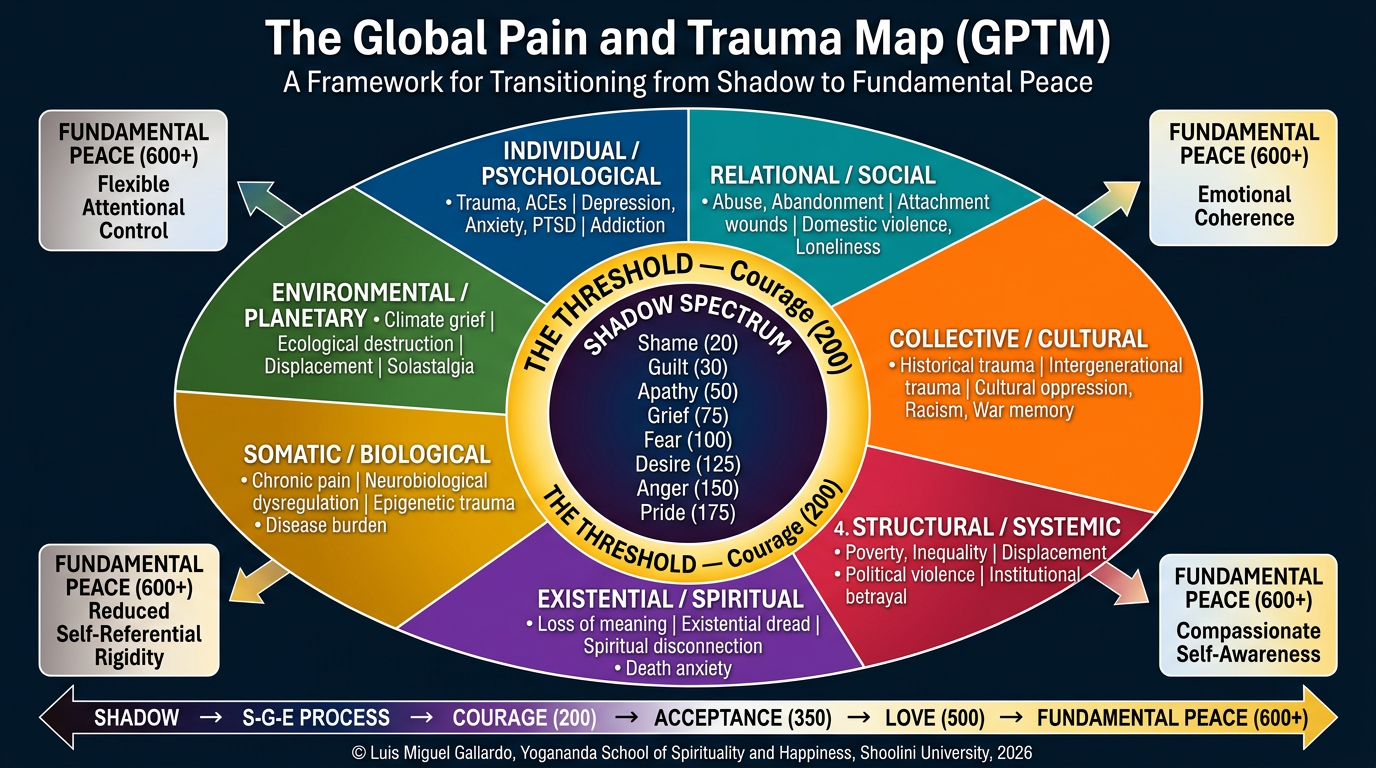
The paper introduces the Global Pain and Trauma Map (GPTM), a seven-domain taxonomy that organizes human suffering across interconnected scales:
- Individual/Psychological — depression, anxiety, PTSD, shame, unprocessed trauma
- Relational/Social — attachment wounds, loneliness, interpersonal violence, betrayal
- Collective/Cultural — war trauma, intergenerational transmission, historical grief, moral injury
- Structural/Systemic — poverty, discrimination, institutional betrayal, mass incarceration
- Existential/Spiritual — death anxiety, loss of meaning, spiritual crisis, disconnection from the sacred
- Somatic/Biological — chronic pain, nervous system dysregulation, addiction, trauma stored in the body
- Environmental/Planetary — climate anxiety, eco-grief, solastalgia, species loss
These domains are not separate compartments. They are deeply entangled. Individual psychological suffering often has roots in relational trauma, which is embedded in collective historical wounds, which are maintained by structural oppression. Treating one domain while ignoring the others produces limited, temporary results.
Each domain in the GPTM is mapped across seven analytical dimensions: how the suffering manifests, where it calibrates on Hawkins’ Map of Consciousness, what neurobiological mechanisms are involved, what the epidemiological data shows, what the Shadow-Gift-Essence transformation pathway looks like, which evidence-based interventions are most effective, and at what scale implementation should occur.
A Crisis of Consciousness
At the heart of the framework is a central insight: the global crisis of suffering is fundamentally a crisis of consciousness.
Drawing on David Hawkins’ Map of Consciousness, the paper identifies a “shadow spectrum” — the emotional states from shame (20) through guilt (30), apathy (50), grief (75), fear (100), desire (125), anger (150), and pride (175) — that characterize contraction, separation, and reactivity. Much of humanity operates within this range. The critical threshold arrives at courage (200), where people begin to take responsibility for their experience and engage with life proactively.
The target isn’t merely symptom reduction. It’s what the paper calls Fundamental Peace — a stable, integrated state of consciousness calibrating at 600 on Hawkins’ scale, defined by four measurable components: flexible attentional control without effortful suppression, emotional coherence across self-states, reduced self-referential rigidity, and compassionate self-awareness. This isn’t a philosophical abstraction. It corresponds to specific patterns of brain activity: reconfigured default mode network, enhanced executive-salience network coupling, high heart rate variability, and elevated neuroplasticity markers.
From Shadow to Essence: The Healing Protocols
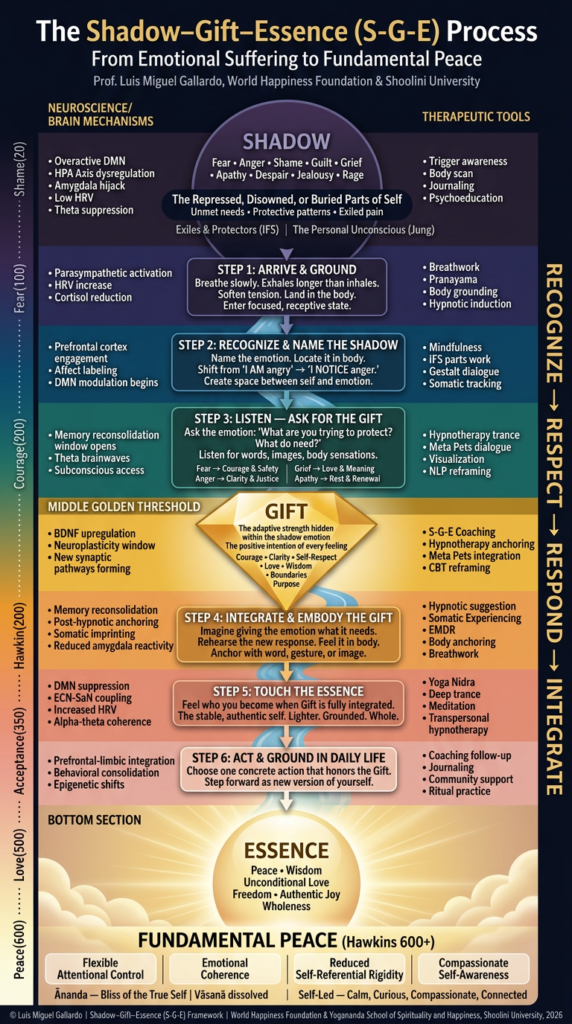
The paper details several evidence-based pathways for moving from shadow to peace. Central among them is the Shadow-Gift-Essence (S-G-E) process — a three-step framework I’ve developed that integrates elements of Jungian shadow work, Internal Family Systems, and contemplative practice:
- Recognize the shadow: Bring the painful emotion into awareness without judgment.
- Ask for the gift: Inquire into the positive intention hidden within the pain. Fear wants to protect. Anger defends boundaries. Shame seeks belonging.
- Embody the essence: Integrate the gift and anchor the transformed state — peace, freedom, compassion, authenticity.
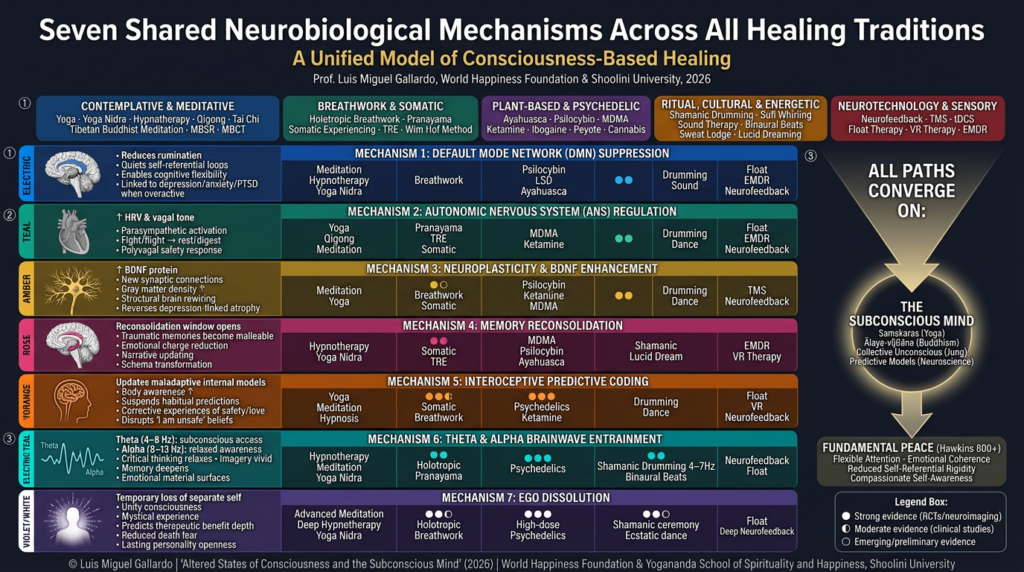
This process can be practiced independently, but it becomes particularly powerful when combined with hypnotherapy and altered states of consciousness — a connection I explored in depth in the Behavioral Sciences paper. Hypnotic trance creates the relaxed, receptive conditions in which shadow material can surface safely, subconscious patterns can be accessed, and new responses can be installed through memory reconsolidation and post-hypnotic suggestion. The neurobiological mechanisms are now well-documented: DMN suppression, theta/alpha brainwave entrainment, enhanced suggestibility, and autonomic nervous system regulation.
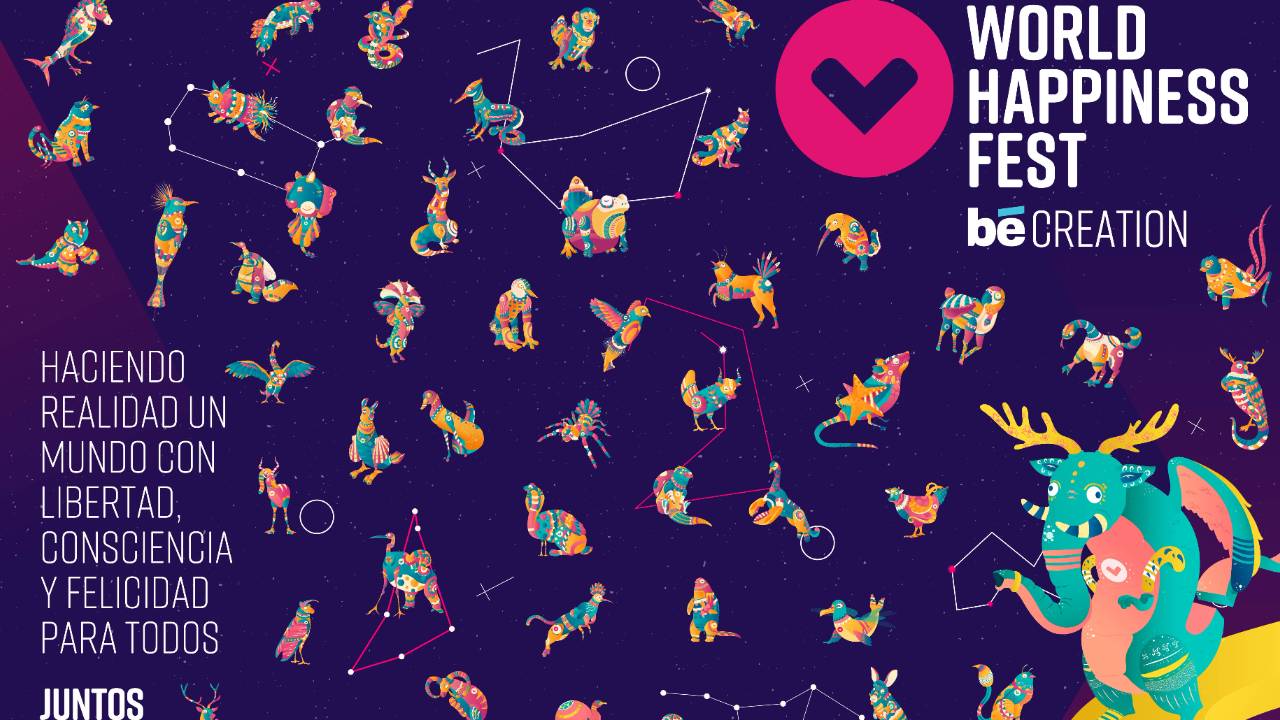
The paper also presents the Meta Pets system — a playful, imaginal approach to shadow work using symbolic cosmic animals to represent internal parts. A frightened rabbit (fear) transforms into a wise owl (discernment) and then into a peaceful dove (trust). By externalizing internal parts as archetypal animals, the system bypasses ego defenses and makes deep psychological work accessible and even joyful — especially for children and trauma survivors.
Beyond the individual level, the paper outlines protocols for community healing (healing circles, truth and reconciliation, collective ritual), institutional transformation (trauma-informed schools, workplaces, and justice systems), and policy-level intervention (universal mental health coverage, poverty reduction, environmental protection).
Why This Matters Now
We are at a breaking point — but also a breakthrough point. The mental health pandemic, ecological crisis, and collective traumas of recent years have made the status quo untenable. The fragmentation of our healing approaches — mind separated from body, individual from collective, science from wisdom — can no longer stand.
This framework is an attempt to offer something integrative: grounded in rigorous epidemiological data and neuroscience, yet open to the experiential wisdom of contemplative traditions. It honors the necessity of individual healing while recognizing that no amount of personal therapy will solve problems rooted in structural violence and collective trauma. And it points toward Fundamental Peace not as a rare spiritual attainment, but as an accessible, measurable state that can be systematically cultivated.
Hawkins’ research suggests that consciousness operates logarithmically — one person at the level of Love (500) counterbalances 750,000 operating below courage (200). One person at Peace (600) counterbalances 10 million. Your personal healing is not a luxury or an indulgence. It is, quite literally, a contribution to planetary transformation.
The journey from shadow to Fundamental Peace is the work of our time. And it begins wherever you are.
Continue Reading: What If Every Healing Tradition on Earth Has Been Targeting the Same Thing?
This blog post summarizes findings from “Mapping Global Pain and Trauma: A Framework for Transitioning from Shadow to Fundamental Peace” by Prof. Luis Miguel Gallardo, Yogananda School of Spirituality and Happiness, Shoolini University. The paper builds on the author’s earlier publication: “Hypnosis as a Mechanism of Emotion Regulation and Self-Integration: An Integrative Review of Neural, Cognitive, and Experiential Pathways to Fundamental Peace”, published in Behavioral Sciences (2026).



Responses