
A New Framework for Understanding — and Healing — Humanity’s Suffering Across 7 Domains, 196 Countries, and 321 Communities
Prof. Luis Miguel Gallardo Founder & President, World Happiness Foundation | Shoolini University | April 2026
Access here: https://worldhappiness.foundation/global-pain-and-trauma-map-gptm/
The Problem: We Only See One-Seventh of Human Suffering
For decades, global mental health policy has been guided by a single question: How many people have a diagnosable psychiatric disorder? The World Health Organization counts depression (264 million), anxiety (301 million), and PTSD (3.9% lifetime prevalence). The World Happiness Report asks citizens to rate their lives on a 0-10 ladder. The Global Peace Index counts conflict deaths and military expenditure.
Each of these indices is valuable. Each is also profoundly incomplete.
A woman in Stockholm may score 7.5 on the WHR life-evaluation ladder — conventionally “happy” — while carrying deep existential purposelessness (Domain 5), chronic somatic tension from decades of performance culture (Domain 6), and escalating eco-anxiety about the warming Arctic she can see from her window (Domain 7). None of these appear in any conventional metric. She is statistically happy and experientially suffering.
A young man in Nairobi may score 4.5 on the WHR — conventionally “unhappy” — yet experience profound relational belonging (Domain 2), cultural pride in his heritage (Domain 3), and spiritual connection through daily practice (Domain 5). His structural suffering (Domain 4: poverty, institutional failure) is real, but his conventional “unhappiness” score obscures three domains where he is already flourishing.
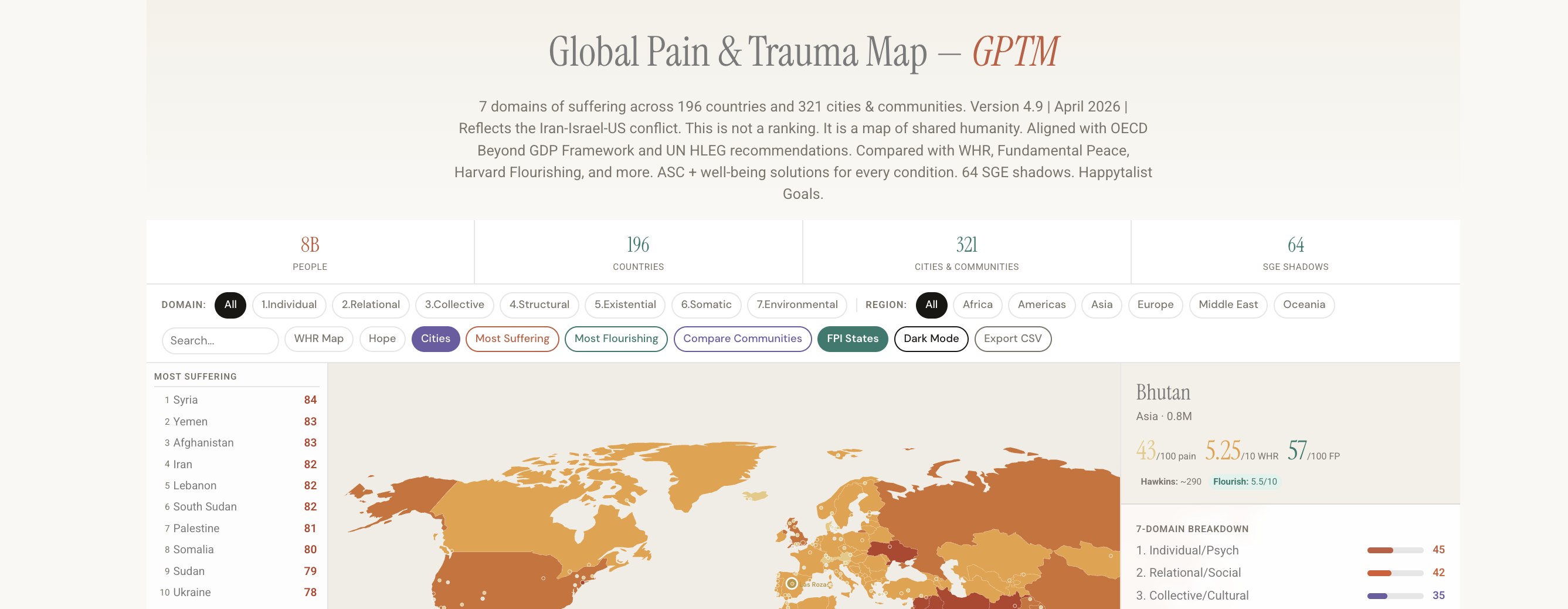
The Global Pain & Trauma Map (GPTM) was built to see what these indices cannot.
What the GPTM Is
The GPTM is an interactive intelligence platform that maps human suffering across 7 domains for 196 countries and 321 cities and communities — from nation-states to indigenous villages, from Blue Zones to crisis zones, from contemplative monasteries to mega-cities.
Each country and community receives a score of 0-100 on each of the seven domains. The composite GPTM score represents the average across all domains. Its inverse — Gallardo’s Fundamental Peace Index (FPI = 100 − GPTM) — measures each community’s proximity to fundamental peace: the state where all seven dimensions of suffering have been addressed and the Shadow-Gift-Essence transformation is substantially complete.
The 7 Domains of Human Suffering
- Individual / Psychological (D1): Depression, anxiety, PTSD, shame, emotional dysregulation. The only domain conventional mental health systems address. 1 billion+ people affected globally.
- Relational / Social (D2): Loneliness, attachment wounds, social isolation, interpersonal violence. 33% of adults globally report significant loneliness. Mortality effects comparable to smoking 15 cigarettes per day.
- Collective / Cultural (D3): War trauma, intergenerational grief, cultural erasure, moral injury. 2 billion people live in conflict-affected zones. Trauma transmits across generations through epigenetics and narrative.
- Structural / Systemic (D4): Poverty, discrimination, institutional betrayal, inequality. 700 million in extreme poverty; 18 million deaths per year from structural violence. Suffering that appears individual but has systemic roots.
- Existential / Spiritual (D5): Meaninglessness, death anxiety, purposelessness, disconnection from the sacred. 40% of adults globally report lacking a clear sense of purpose. Invisible to all conventional metrics yet the strongest single predictor of low flourishing (r = −0.88 with Harvard Flourishing Index).
- Somatic / Biological (D6): Chronic pain, addiction, burnout, nervous system dysregulation. 1.5 billion people live with chronic pain. The body stores trauma the mind cannot access. In 40% of countries, D6 exceeds D1 — the body suffers more than the mind.
- Environmental / Planetary (D7): Climate anxiety, eco-grief, nature deficit, species grief. 75% of young people globally report significant climate anxiety. Background existential dread that compounds all other domains.
Gallardo’s Fundamental Peace Index
The Fundamental Peace Index (FPI) is not the absence of conflict. It is the active presence of well-being across all seven dimensions of human experience.
Key FPI findings from the GPTM data:
- Global average FPI: ~37 (Hawkins ~210, barely above Courage). Humanity as a whole has not yet crossed the threshold from force-based to power-based collective consciousness.
- Only 12 countries exceed FPI 50. None exceed FPI 60. No nation-state has achieved fundamental peace.
- Plum Village (FPI 77), the contemplative community founded by Thich Nhat Hanh, comes closest to fundamental peace among all 272 mapped communities.
- FPI correlates r = 0.88 with Harvard Flourishing composite — stronger than WHR (r = 0.82) or GDP per capita (r = 0.65). The FPI captures human flourishing more completely than any existing single index.
- Each 10-point FPI increase ≈ $2,400 GDP per capita equivalent in well-being value, based on subjective well-being valuation literature.
Statistical Findings: What the Data Reveals
Cross-Index Correlation Matrix
Ten Key Findings
1. The Hidden Suffering Gap. Countries scoring above 6.0 on the WHR still average GPTM 58 — meaning they carry substantial suffering across domains that happiness surveys cannot see. The WHR Cantril ladder captures life evaluation but misses somatic pain, collective trauma, and ecological grief. Happiness surveys undercount suffering by approximately 40%.
2. The Nordic Paradox Explained. Nordic countries (WHR average 7.4, GPTM average 49) have solved structural suffering (D4: 33) through welfare states and cultural suffering (D3: 33) through social cohesion. But their existential suffering (D5: 58) and environmental suffering (D7: 72) remain elevated. Material security does not resolve meaning-hunger or eco-grief.
3. The Consciousness Threshold at FPI 65. Communities crossing FPI 65 (Hawkins ~350, Acceptance) show discontinuous improvement: D2 drops below 35, D5 below 25. This marks the empirically observed shift from force-based to power-based collective consciousness. Plum Village (FPI 77), Findhorn (FPI 70), and Auroville (FPI 67) all demonstrate this pattern.
4. The $16.5 Trillion Violence-Consciousness Link. The Institute for Economics and Peace estimates $16.5 trillion in annual global violence costs. GPTM D3+D4 (conflict + structural suffering) correlate r = 0.91 with violence expenditure. Investing 1% ($165 billion) in ASC and well-being interventions across the 20 highest-GPTM countries could reduce violence costs by 15-25%.
5. D5 Is the Master Domain. Existential suffering predicts Harvard Flourishing at r = −0.88, stronger than any other domain. D5 also mediates the relationship between D1 (psychological) and D2 (relational) suffering. Addressing meaning and purpose through contemplative practice is the highest-leverage single intervention available.
6. The Body Keeps the Score — Globally. D6 (Somatic) averages 62 globally. In 40% of countries, D6 exceeds D1 — the body suffers more than the mind recognizes. Countries where D6 > D1 (e.g., Russia D6: 82, D1: 78) require somatic-first interventions: Somatic Experiencing, TRE, yoga, breathwork — before cognitive approaches can be effective.
7. Indigenous Flourishing Pattern. Indigenous communities (Hadza D2: 28, Kogui D5: 18, Sámi D7: 32) score 15-25 points lower on relational (D2) and existential (D5) suffering than their host nations. Their structural suffering (D4: 70+) remains high due to systemic marginalization, but relational and spiritual flourishing persists despite material deprivation.
8. The 7-Domain Integration Bonus. Communities addressing all 7 domains simultaneously show a 15-20% non-linear improvement bonus. Auroville and Findhorn demonstrate that when no domain is left untreated, total suffering drops faster than the sum of individual reductions. Partial interventions produce partial results. Only holistic approaches produce flourishing.
9. ASC as Universal Therapeutic Target. Gallardo’s comprehensive review of Altered States of Consciousness (2026) identifies 7 neurobiological mechanisms shared across 25+ ASC modalities: default mode network modulation, autonomic nervous system regulation, BDNF-mediated neuroplasticity, memory reconsolidation, interoceptive predictive coding, theta/alpha entrainment, and ego dissolution. These mechanisms operate across all 7 GPTM domains and all 64 Meta Pets shadows, confirming the subconscious mind as the universal therapeutic target.
10. The FPI Trajectory to 10 Billion Happy. Current global FPI: ~37. Target: FPI 65+ for 80% of humanity by 2050. This requires a 28-point increase over 25 years (~1.1 points per year). New Zealand’s well-being budget achieved approximately +3 FPI over 5 years, demonstrating feasibility. If 50+ nations adopt the GPTM framework by 2030, the World Happiness Foundation’s vision of 10 billion free, conscious, and happy people by 2050 becomes achievable.
The 64 Shadows of Humanity
The GPTM integrates the Meta Pets Method (Gallardo), which maps 64 archetypal shadows operating in the subconscious mind — derived from the Gene Keys system (Rudd) and the I Ching. Each shadow contains a gift that, when activated through ASC modalities and well-being practices, leads to its essence: the flourishing state.
When a country scores high on a GPTM domain, the corresponding Meta Pets shadows are most active in its collective consciousness. The Shadow-Gift-Essence (S-G-E) transformation process moves individuals and communities from shadow through gift to essence, directly reducing the GPTM pain index and increasing the Fundamental Peace Index.
Shadows like Stress (#52), Desire (#30), Judgment (#18), and Superficiality (#20) appear across ALL country profiles regardless of income level. These are universal human conditions, not development-stage problems.
From Diagnosis to Prescription: The Intervention Architecture
The GPTM is not merely a diagnostic tool. For every domain, every country, and every community, it provides specific intervention pathways:
ASC Clinical Modalities (25+ mapped, with evidence levels):
- RCT-validated: EMDR, Psilocybin-assisted therapy, MDMA-assisted therapy, MBCT, TMS, Ketamine
- Meta-analysis supported: Mindfulness, Yoga, Tai chi, Clinical hypnosis, Neurofeedback
- Open trial: Somatic Experiencing, Float therapy, Holotropic breathwork, Wim Hof
- Emerging: LBL hypnotherapy, PLR therapy, Community drumming, Ecstatic dance
Well-Being & Happiness Practices (50+ mapped):
- Gratitude journaling, Acts of kindness, Social prescribing, Ikigai workshops, Death cafés, Active hope workshops, Community belonging circles, Reforestation days, and many more — each mapped to specific GPTM domains.
The five lowest-cost interventions (school mindfulness at $2-5/person/year, community breathwork at $5-15, group tai chi at $8-20, community drumming at $3-10, and gratitude programmes at $1-5) address all 7 GPTM domains and can reach millions. Deploy these universally first; reserve high-cost clinical modalities for treatment-resistant cases.
Implementation Intelligence: Who Is Already Leading?
The GPTM maps global best practices already working:
- New Zealand: Well-being Budget (2019) — first national budget measured against well-being outcomes, not just GDP
- Bhutan: Gross National Happiness — pioneered happiness as a governance metric
- UAE Ministry of Happiness: Government-level happiness infrastructure
- Las Rozas, Spain: Aspiring to become the world’s first Smart City of Happiness & Consciousness, integrating all 7 GPTM domains with the Wheel of Happiness (9 spheres)
- Mondragon, Spain: Cooperative economy model — D4 score of 30 (vs. national average 55)
- Okinawa, Japan: Blue Zone longevity — D6 score of 30 through lifestyle and ikigai
- Plum Village, France: Contemplative community — D5 score of 15, highest FPI of any mapped community
The Road to 10 Billion Happy by 2050
The World Happiness Foundation’s mission is 10 billion free, conscious, and happy people by 2050. The GPTM provides the intelligence infrastructure to make this measurable and achievable:
Phase 1 (2026-2030): 50 nations adopt GPTM as complementary mental health framework. 100 cities pilot the Las Rozas model. 10,000 practitioners trained in ASC modality clusters.
Phase 2 (2030-2040): Global FPI tracking integrated into UN SDG reporting. Regulatory pathways for psychedelic-assisted therapy in 30+ countries. School mindfulness universal in OECD nations. Community belonging circles in every municipality over 50,000.
Phase 3 (2040-2050): Global average FPI reaches 55 (Hawkins 300+). 80% of humanity above FPI 50. The first nation-state achieves FPI 65 — fundamental peace. The 64 shadows understood as a universal map of human development, not pathology.
Explore the Map
The complete interactive GPTM is available as a single HTML file — no installation, no account, no subscription. Download it, open it in any modern browser, and explore:
- Click any country for its full 7-domain profile, Hawkins estimate, WHR comparison, SGE analysis, Meta Pets shadow mapping, and specific ASC + well-being recommendations
- Click any city dot for community-level insights
- Switch between Pain view, Hope view, and WHR map
- Filter by domain to see where each type of suffering concentrates
- Filter by region to compare world areas
- Use the intervention simulator to project impact
- Export data for your own analysis
This is not a ranking. It is a map of shared humanity.
Contact & Partnerships
The GPTM is a living document. We welcome contributions from researchers, policymakers, community leaders, indigenous wisdom keepers, and anyone with data, insights, or corrections.
Prof. Luis Miguel Gallardo Founder & President, World Happiness Foundation Email: [email protected] Web: worldhappiness.foundation | worldhappinessacademy.org
Based on “Mapping Global Pain and Trauma: A Framework for Transitioning from Shadow to Fundamental Peace” and “Altered States of Consciousness and the Subconscious Mind: A Comprehensive Comparative Review” by Prof. Luis Miguel Gallardo, Shoolini University, 2026.
The Global Pain & Trauma Map (GPTM) and Gallardo’s Fundamental Peace Index (FPI) are research tools of the World Happiness Foundation. Data sources include WHO Global Burden of Disease, Gallup World Poll, ACLED, World Bank, Lancet Planetary Health, and the author’s 7-domain analytical framework. All findings are preliminary and subject to validation through longitudinal studies.




Responses