
GPTM Article Series — No. 1 of 10
How the wealthiest nation on Earth carries some of the deepest invisible wounds — and how a few actors sustain a system of suffering through violence, dominance, and militarism
By Prof. Luis Miguel Gallardo Founder & President, World Happiness Foundation & Shoolini University April 2026 · Based on the Global Pain & Trauma Map (GPTM) v4.9
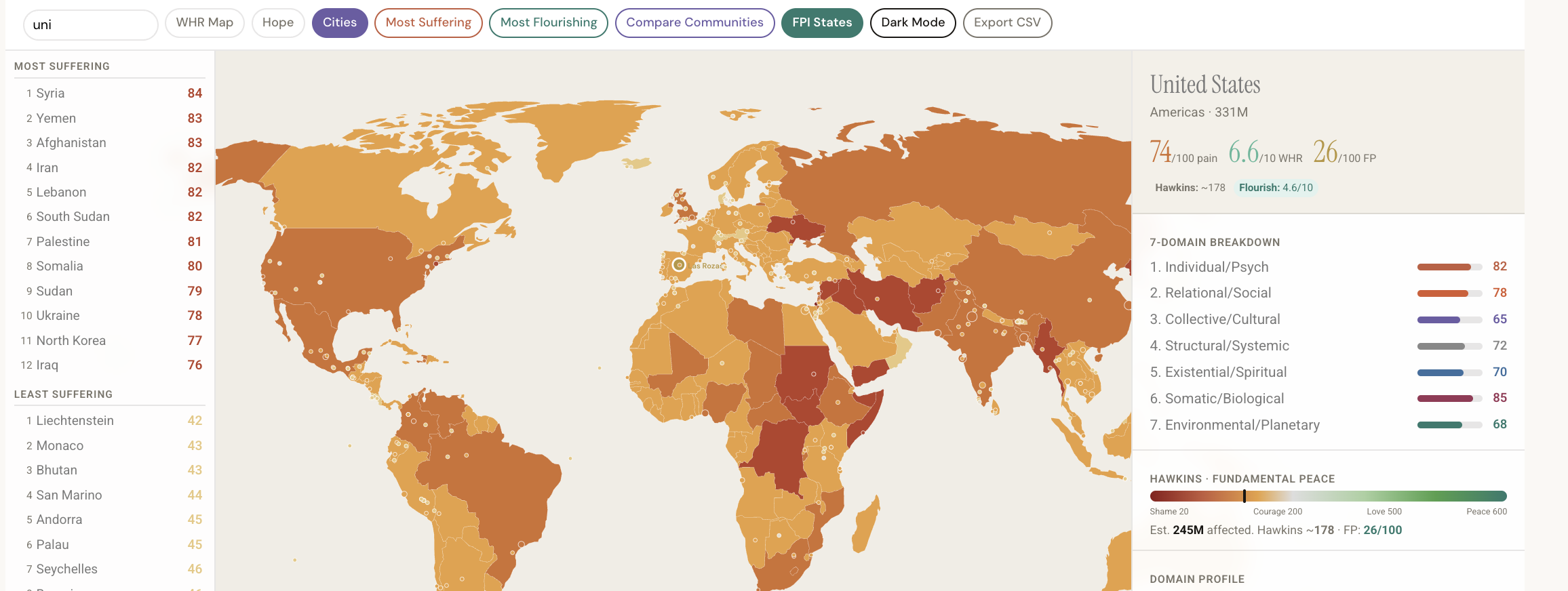
The United States of America — GDP per capita $85,000, the world's largest economy, the planet's dominant military power — scores 72 out of 100 on the Global Pain and Trauma Map composite. That is higher than the global average of 65. By the GPTM's measure, the richest country in history carries more total suffering than most of the world. This article asks: why? And who benefits from keeping that suffering invisible?
I. The Paradox the World Happiness Report Cannot See
Every year, the World Happiness Report places the United States somewhere around 15th to 25th among nations, with a Cantril ladder score hovering near 6.7 out of 10. Americans, when asked to evaluate their lives on a scale from worst to best possible, give a reasonably positive answer. And yet something is deeply, structurally wrong.
The GPTM reveals what the WHR's single question cannot: suffering is not one thing. It has seven dimensions, and the United States scores critically high on most of them. The WHR captures life evaluation — a cognitive judgment. It misses the body, the collective, the existential, and the ecological. It misses the pain that Americans carry in their nervous systems, their communities, their sense of meaning, and their relationship with the planet.
When we map all seven domains, the portrait is devastating.

Look at D6: 85 out of 100. The United States has the highest somatic suffering score of any high-income country on Earth. This is a nation where the body is screaming and the metrics are not listening.
II. The Numbers That Tell the Hidden Story
Consider what these domain scores actually represent in human lives. Every number in the GPTM corresponds to real people, real bodies, real communities in pain.
Domain 1 — Psychological: Approximately 60 million American adults experience a diagnosable mental illness in any given year. One in ten adults reported a mental health crisis in the past year, according to a Johns Hopkins study published in 2025. Among young adults aged 18 to 29, that figure rises to 15%. Among those experiencing housing instability, it reaches 38%. Two-thirds of Americans report anxiety about current world events.
Domain 6 — Somatic: Since 1999, nearly 1.3 million Americans have died from drug overdoses. The opioid epidemic alone is projected to cost $367 billion in 2025 and a cumulative $5.8 trillion over the next 15 years. Every single day, approximately 130 Americans are killed with guns and more than 200 are shot and wounded. Firearms became the leading cause of death for Americans aged 1 to 19 in 2020, and remain so. The U.S. gun homicide rate is 26 times that of other high-income countries.
Domain 2 — Relational: The United States is experiencing what the Surgeon General has called a loneliness epidemic. Approximately one-third of American adults report serious loneliness, with health effects equivalent to smoking 15 cigarettes per day. Young Americans are lonelier than seniors. Social trust has collapsed to historic lows.
Domain 4 — Structural: Forty percent of the U.S. population — 137 million people — live in a designated Mental Health Professional Shortage Area. The wealthiest nation cannot provide basic psychological care to its own citizens. Meanwhile, the top 1% of Americans hold more wealth than the bottom 50% combined. This is not an accident. It is a structure.
The GPTM insight: The United States scores 72/100 on the GPTM — a Fundamental Peace Index of just 28. That places it in the "Crisis" tier (FPI 0–30), calibrated at approximately Hawkins 190, which is below the level of Courage (200) on the Map of Consciousness. A nation with $85,000 GDP per capita operates, in terms of collective consciousness, from a state of Pride and close to Fear. Money did not buy peace. It bought the capacity to hide suffering.
III. The United States Compared to the 30 Most Suffering Communities
When we place the United States alongside the GPTM's most suffering communities, the comparison is instructive — not because America's suffering is identical, but because the pattern reveals something the conventional narrative obscures.

The pattern is unmistakable. In the 30 most suffering communities, the dominant domain is almost always D3 (Collective/Cultural) or D4 (Structural/Systemic) — war, institutional collapse, extreme poverty. These are suffering imposed from outside or above: by conflict, by colonialism's legacy, by structural violence.
The United States breaks the pattern. Its highest domain is D6 (Somatic) — the body. Americans are not suffering primarily from war or absolute poverty. They are suffering from what the body stores when the mind is told everything is fine. Addiction. Chronic pain. Burnout. Nervous system dysregulation. The opioid epidemic is not a drug problem. It is the body's revolt against a system that has no space for human vulnerability.
IV. Today's Pain Is Built on Hidden Pain
The central thesis of the GPTM is that visible suffering is always rooted in invisible suffering. The seven domains interact: trauma in one domain amplifies pain in all others. And in the United States, the foundational hidden pain runs through three channels.
1. The Unprocessed Collective Trauma (D3)
The United States was founded on two original traumas that have never been collectively processed: the genocide of Indigenous peoples and the enslavement of Africans. These are not historical footnotes. The GPTM's 7-domain integration effect shows that unprocessed D3 (collective) trauma amplifies D1 (psychological), D2 (relational), and D4 (structural) suffering across generations through epigenetic transmission, cultural narrative, and institutional design. The descendants of enslaved people still experience higher rates of chronic illness, shorter life expectancy, and greater psychological distress — not because of individual failure, but because collective trauma was never named, never mourned, never integrated through the Shadow-Gift-Essence process.
2. The Loneliness Architecture (D2)
American society was redesigned after World War II around the automobile, the suburb, and the nuclear family — a radical experiment in social isolation. The result: the systematic destruction of the communal infrastructure that every human society has depended on for belonging. Extended family networks, walkable neighborhoods, village squares, community rituals — all replaced by highways, strip malls, and screens. The GPTM data shows that the most flourishing communities on Earth (Plum Village, GPTM 24; Okinawa, GPTM 33; Ikaria, GPTM 32) share one structural feature: daily in-person communal gathering. The United States engineered its opposite.
3. The Meaning Crisis (D5)
With a D5 score of 68, the United States experiences existential suffering far above the global average. This is the dimension the World Happiness Report misses most completely. Americans report satisfaction with their lives while experiencing a profound deficit of purpose, meaning, and spiritual grounding. The GPTM finds that communities with active contemplative traditions — Bhutan (D5: 30), Plum Village (D5: 15), Kogui Indigenous (D5: 18) — score dramatically lower on existential suffering regardless of wealth. Africa, with the highest structural suffering on Earth, maintains D5 scores averaging just 39 — lower than the U.S. — because Ubuntu philosophy, communal spirituality, and ancestral connection provide meaning that GDP cannot.
V. A Few People Creating Immense Pain
The GPTM does not merely describe suffering. It asks: who benefits from it? And on this question, the United States provides the clearest case study on Earth.
The Military-Industrial Complex
The Trump administration's proposed FY2027 defense budget stands at $1.5 trillion — the largest military request in decades, a 44% increase. The United States accounts for 42% of all global arms exports, more than the next four exporters combined.
Meanwhile, the GPTM estimates that the four lowest-cost well-being interventions — school mindfulness, community breathwork, community drumming, and gratitude programs — cost just $1–15 per person and could reach 1 billion people per year for $5–15 billion. That is less than 1% of the proposed military budget.

In April 2026, as the Iran war unfolds, the President of the United States stated publicly that the nation cannot afford daycare, Medicaid, or Medicare because it is fighting wars. The defense budget has been proposed at $1.5 trillion while domestic programs are cut by 10%. This is not an economic necessity. It is a choice — made by a small number of people who profit from the architecture of violence.
The GPTM data confirms: the annual global cost of violence is $16.5 trillion (Institute for Economics and Peace). D3 and D4 correlate at r = 0.91 with that cost. The violence industry does not merely fail to reduce suffering — it actively produces it, across every domain, in every country it touches, including the United States itself. American veterans return with PTSD (D1), broken relationships (D2), collective moral injury (D3), structural abandonment by the VA (D4), existential crisis (D5), chronic pain and traumatic brain injury (D6), and ecological devastation at every base and theatre of operation (D7). All seven domains. The machine produces suffering in all of them.
Capitalism Without Democracy and Without Fundamental Peace
The United States practices a specific form of capitalism — one in which the market operates without democratic constraint in critical domains: healthcare, housing, education, and incarceration. The result is predictable from the GPTM framework.
When healthcare is a commodity, D6 (somatic) suffering concentrates among the poor. When housing is a speculative asset, D2 (relational) suffering intensifies as communities are displaced. When education is gated by income, D4 (structural) suffering reproduces itself across generations. When prisons are profitable, D3 (collective) trauma is industrialized — the United States incarcerates more people than any nation on Earth, disproportionately Black and brown, perpetuating the original D3 wound of racial violence.
The GPTM introduces the concept of Fundamental Peace — not the absence of conflict, but the active presence of well-being across all seven domains. Capitalism without Fundamental Peace is extraction: it concentrates wealth while distributing suffering. The Fundamental Peace Index for the United States is 28 out of 100. For comparison: Plum Village, a community of monks who own nothing, scores FPI 78. Ikaria, a Greek island where people "forget to die," scores FPI 68. Pinecrest, Miami — the first City of Happiness — scores FPI 58.
"Fundamental Peace is not the absence of suffering — it is the active presence of all seven dimensions of flourishing." — Prof. Luis Miguel Gallardo
The United States, with all its wealth, all its technology, all its military power, has not achieved what a village of contemplative monks in France has achieved: a state where human beings can live without crushing pain in every dimension of their experience.
VI. The Shadow-Gift-Essence of American Pain
The GPTM's Shadow-Gift-Essence model teaches that every shadow contains a gift. The shadow is the unconscious pattern. The gift is the conscious activation. The essence is the flourishing state.
The dominant shadows operating in the United States collective consciousness, mapped to its GPTM profile, include:
Shadow #52: Stress (D6) — The gift is Restraint. The essence is Stillness. A culture of perpetual productivity must learn to stop. The somatic epidemic is the body saying: enough.
Shadow #30: Desire (D4/D5) — The gift is Lightness. The essence is Rapture. A consumer culture built on wanting must discover that fulfillment comes from being, not having. This is the shift from GDP to Gross Global Happiness.
Shadow #20: Superficiality (D2/D5) — The gift is Self-Assurance. The essence is Presence. A society addicted to performance and image must learn to be present with itself and with others. The loneliness epidemic is the wound. Belonging is the gift.
Shadow #18: Judgment (D2/D3) — The gift is Integrity. The essence is Perfection. A polarized nation must move from judging others to knowing itself. The culture wars are the shadow. Reconciliation is the gift.
VII. What Would Healing Look Like?
The GPTM does not only diagnose. It prescribes. For the United States, the prescription is clear across all seven domains, using the same evidence-graded modalities and community models that work everywhere on Earth.
For D6 (Somatic, score: 85): Scale somatic experiencing, yoga, and float therapy nationwide. Prescribe nature as a clinical intervention. End the opioid pipeline by investing in non-opioid pain management and addressing the structural despair that drives addiction. Learn from Okinawa (D6: 30) — where longevity comes from community, movement, and purpose, not pharmaceuticals.
For D1 (Psychological, score: 82): Deploy EMDR in every community health center. Fund psilocybin and MDMA clinical trials at scale. Train 100,000 practitioners in ASC modalities. The evidence base exists — RCTs for EMDR, psilocybin, and MBCT show efficacy equal to or greater than pharmaceutical interventions, at a fraction of the long-term cost.
For D2 (Relational, score: 75): Redesign communities around belonging, not automobiles. Fund belonging circles, Ubuntu-inspired community practice, and Nonviolent Communication programs in every school. Learn from the Hadza (D2: 28), whose relational bonds are the strongest measured on Earth.
For D4 (Structural, score: 72): Adopt well-being budgets, following New Zealand's model. Redirect even 1% of the military budget — $15 billion — to community well-being interventions. That single reallocation could fund the four lowest-cost GPTM interventions (school mindfulness, community breathwork, community drumming, and gratitude programs) for 1 billion people per year.
For D5 (Existential, score: 68): Integrate contemplative practice into education, following Bhutan's model. Support ikigai (purpose) programmes. Create regulatory pathways for psilocybin-assisted therapy for existential distress. Learn from Plum Village (D5: 15) — where monks demonstrate that daily mindfulness eliminates existential suffering entirely.
The math is simple: The four lowest-cost well-being interventions cost $1–15 per person. The U.S. military budget is $1.5 trillion. Redirecting 1% would provide $15 billion — enough to deliver school mindfulness, community breathwork, belonging circles, and gratitude programs to every American, every year. The interventions exist. The evidence exists. The money exists. What is missing is consciousness.
VIII. From Shadow to Fundamental Peace
The United States is not a hopeless case. It is, in the GPTM's Action Priority Matrix, an "Opportunity" country — high pain combined with high feasibility. It has the resources, the institutional capacity, the research infrastructure, and the cultural diversity to transform. It also has models already working within its borders.
Pinecrest, Miami — the first City of Happiness in the world — demonstrates that a community of 19,000 can integrate all nine dimensions of the Wheel of Happiness into city governance. From Pinecrest, 60,000+ Teachers of Happiness have been trained across Latin America. One community seeded a continental movement.
Esalen, Big Sur — an intentional community where holistic practices have been sustained for decades — scores among the lowest GPTM composites in the United States, proving that the American context is not inherently hostile to flourishing.
Loma Linda, California — a Blue Zone where Seventh-day Adventists live ten years longer than the American average — demonstrates that community, plant-based nutrition, and shared purpose can overcome the structural pathologies of American life.
The path from shadow to Fundamental Peace is not a mystery. It has been walked by communities around the world. The GPTM maps it. The SGE process names it. The ASC modalities and well-being practices power it. The Schools, Cities, Enterprises, and Hospitals of Happiness deliver it. And the Happytalist Goals set the civilizational direction.
What the United States needs is not more wealth, more technology, or more military power. It needs what Plum Village has: a daily collective practice of awareness, compassion, and belonging. It needs what Bhutan has: governance that measures happiness, not production. It needs what the Kogui have: a 10,000-year understanding that human beings belong to the Earth, not the other way around.
The hidden pain of the United States is not hidden because it is small. It is hidden because the system that produces it has every incentive to keep it invisible. The GPTM makes it visible. And visibility is the first step toward healing.
"A scarcity mindset creates limitations, whereas an abundance mindset allows us to think big." — Prof. Luis Miguel Gallardo, Beyond Scarcity: Embracing Happytalism for a World of Abundance
Next in this series: Article #2 — "Africa's Hidden Strength: Why the Continent with the Most Structural Suffering Has the Least Existential Pain"
World Happiness Foundation worldhappiness.foundation · worldhappinessacademy.org · gallardohypnotherapy.com
Global Pain & Trauma Map (GPTM) v4.9 · April 2026 · 196 countries · 321 cities & communities Prof. Luis Miguel Gallardo · Shoolini University
"10 Billion Free, Conscious, and Happy by 2050"



Responses