
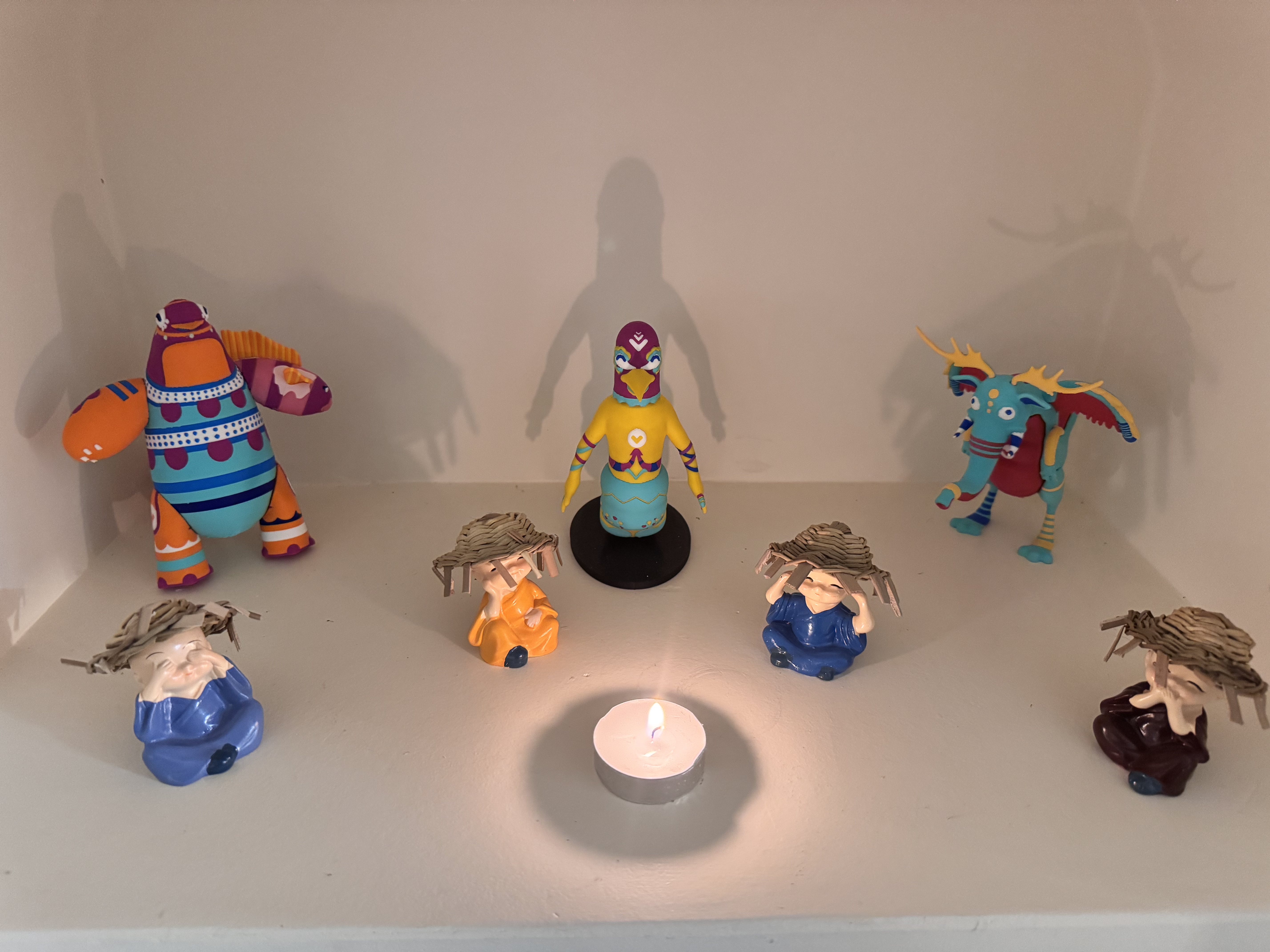
An invitation to peace — beginning, as it always must, with whatever is loudest today.
By Prof. Luis Miguel Gallardo
This week, the word on every screen is peace.
A war that filled the spring with fire was declared over on paper. An agreement was signed, the cameras assembled, and the analysts began their long argument about whether it will hold. I will leave that argument to them. What I notice, watching from Madrid, is something quieter and more universal — the strange ache of hearing the word peace spoken so constantly by a world that feels so far from it.
Because even as one conflict pauses, the noise does not. The feeds do not stop. An economy that has just produced its first trillionaire leaves millions feeling the daily squeeze of not enough. Machines appear to be rewriting the meaning of work faster than we can think about it. And underneath all of it — under the war and the truce, the markets and the algorithms — most of us are carrying a private version of the very thing the headlines are negotiating: a longing for a peace we cannot quite locate.
Here is what two decades of this work have taught me. The peace the headlines mean and the peace a human being actually needs are not the same peace — and only one of them can be signed by someone else.
The peace that cannot be signed
A treaty can stop the shooting. It cannot reach a nervous system. No agreement between governments has ever once travelled down into the body of an ordinary, frightened person and told it that it is safe to rest. That work is not done at a negotiating table. It is done inside, one human being at a time, and it cannot be delegated.
This is the peace I have spent my life studying, and I want to be precise about what it is — because the word has been worn so thin by overuse that we have half-forgotten it points at something real. Fundamental Peace is not a mood, a personality trait, or a spiritual decoration. It is a measurable neuro-experiential state — work I published this year, with Saamdu Chetri, in the journal Behavioral Sciences — with identifiable components and clear correlates in the brain. It is the steadiness from which a person can feel everything happening around them and still choose their response, rather than be run by it.
And it is crucial to say what it is not. Fundamental Peace is not the absence of pain. It is the transmutation of its energy into love and compassion. It is not numbness, not denial, not the flat calm of someone who has stopped caring about the world. It is the opposite of all of those: a deep, awake steadiness that lets you stay in contact with a painful world without being shattered by it. That distinction is the whole thing — and it is the reason a person can be at peace in the middle of a week like this one.
Start with what is loudest in you
You cannot quiet the whole world today. That is simply true, and pretending otherwise is its own kind of suffering. But there is something you can do, and it is not small: you can turn toward whatever the noise has made loudest inside you.
For one person this week it is fear — a body that will not sleep, a mind rehearsing every catastrophe the news has handed it. For another it is grief, the world changing shape without asking. For another it is a low, simmering anger, or a numbness that has quietly replaced feeling, or the old conviction that whatever they do, it will never be enough. The form is different in each of us. The mechanism is the same: that loud inner voice is not your enemy. It is a signal, pointing with surprising accuracy at exactly what your inner ground most needs.
So that is where I would have you begin — not with theory, and not with the whole burning world, but with the single loudest thing in you right now. I have gathered the heart of this work into one place built around precisely that principle: an invitation to peace, organised by whatever is loudest today. You choose the voice — I feel afraid, I am grieving, I am angry, I never feel enough — and it walks you to the essay that meets that experience directly, and then to the inner ground beneath it.
If what is loudest is the alarm in the body, begin there: when anxiety won’t let you land. If a loss has changed the shape of your world, begin with grief — the shape love takes when what we love is gone. If there is heat that will not cool, begin with the anger that is really boundary energy looking for direction. Each one meets you where you actually are, names the experience without flinching, and ends with a single next step — not a lecture, a practice.
This is not a retreat from the world
I can hear the objection, because I have felt it myself. In a week like this, isn’t turning inward a kind of luxury — or worse, an escape? Shouldn’t we be doing something about the state of things, not tending our own interior?
I want to answer this directly, because it matters, and because it is the conviction the entire Happytalism paradigm and the work of the World Happiness Foundation rest upon. The inner work is not a retreat from the world. It is the most upstream form of action there is.
We will not build a peaceful world out of nervous systems at war. The outer peace we long for — in our families, our institutions, our nations — is not assembled by frightened, reactive, divided people, however good their intentions. It is built by human beings who have found some genuine measure of peace inside themselves, and can therefore act from clarity rather than panic, from care rather than contempt. A population running on fear builds systems that run on fear. The reverse is also true, and far more hopeful. Every person who does this work becomes what I call a conscious catalyst — someone who steadies the field around them simply by being steady in it. That is not a withdrawal from the crisis of our time. It is how the crisis is met.
Peace you can practise
The good news — and after this kind of week, it is genuinely good news — is that this peace is not a mystery reserved for monks and mystics. It is trainable, and it is measurable.
You can read your own baseline in about five minutes with the FP20 Fundamental Peace Scale, which turns an invisible inner state into a number you can actually track over time. You can tend it in small daily increments with a short daily practice, because peace, like anything alive, responds to attention. And underneath every loud emotion runs the same quiet pattern I call Shadow → Gift → Essence: the difficult feeling is a signal, the signal carries a gift, and the gift opens onto a quality that was in you all along. If you lead others — a team, a family, an organisation — the same inner steadiness becomes a way of leading through the six pillars of the ROUSER model. Measure it, tend it, practise it. That is the whole arc, and anyone can begin it today.
The invitation
The peace being signed this week may hold, or it may not. That is beyond your hands and mine today, and it is right to hope for it. But there is another peace that is within your hands — and it does not begin with the whole world. It begins with the single loudest thing in you right now, and your willingness to turn toward it with steadiness instead of away from it in fear.
Your peace is not a luxury to be claimed once the crisis has passed. It is how the crisis is met — and it is how, eventually, a less frightened world gets built.
So let this be the invitation. Find the voice in you that is loudest today. Read the one essay that meets it on the peace pathways, and take the single next step it offers. Then, if you want to see the ground you are standing on, measure your peace with FP20. Five quiet minutes, in the middle of a loud world. It is more than enough to begin.
Prof. Luis Miguel Gallardo is the Founder and President of the World Happiness Foundation, creator of the Happytalism paradigm and the ROUSER model of conscious leadership, and developer of the Integrative Transformation Model. He is a Clinical and Transpersonal Hypnotherapist and an ICF PCC coach, and holds UN ECOSOC and University for Peace affiliations through his work. You can learn more about his work, and explore the free Fundamental Peace essays, tools and library at lmgallardo.org.



Responses